Four disciplines, taught to the level the job demands.
Every programme is scoped to the client's equipment and crew experience, delivered in the classroom, the workshop or on location, and closed out with written and practical assessment.
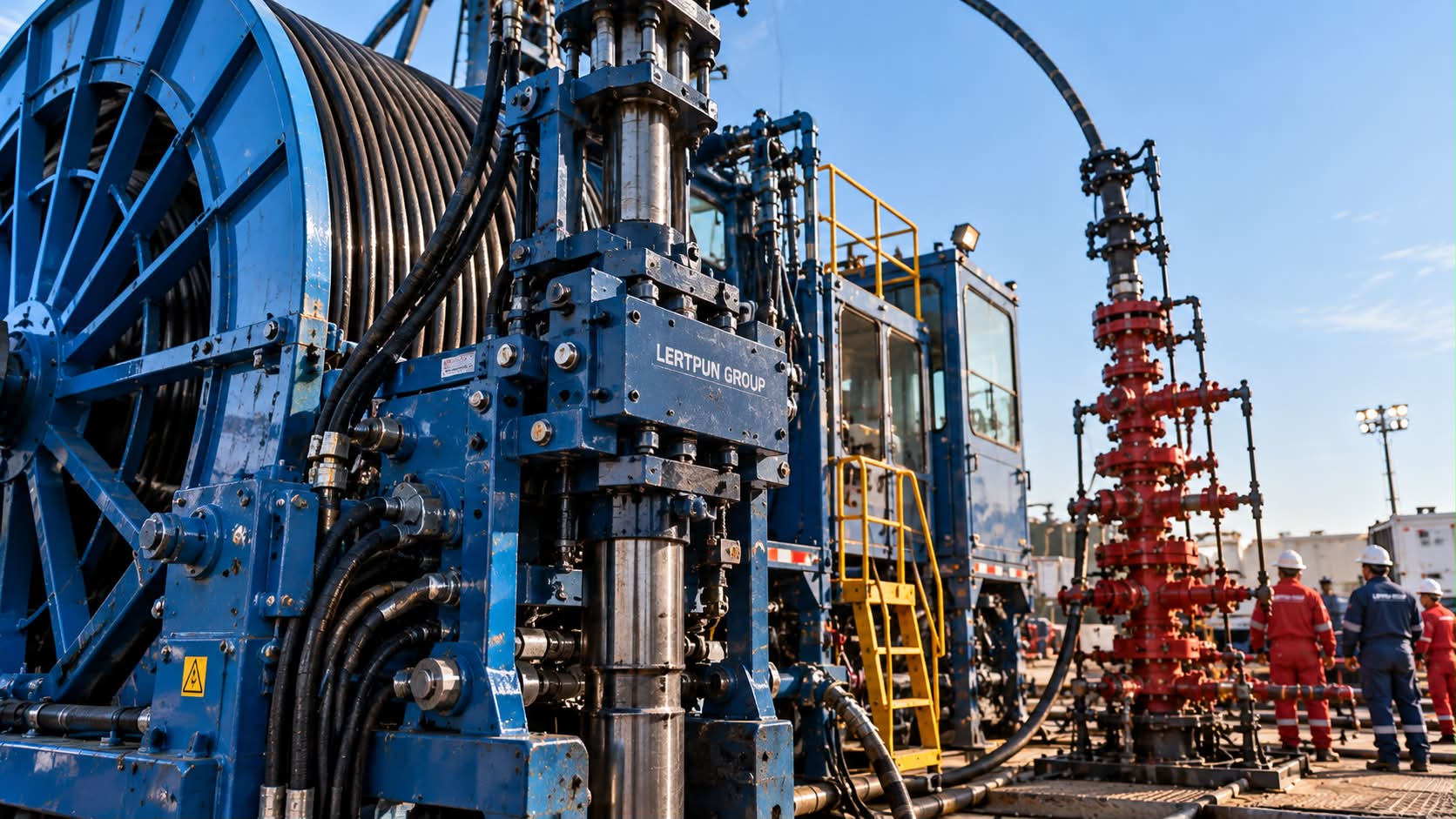 Injector head and reel, rigged up
Coiled Tubing
The core discipline, and the one our founder taught at Schlumberger's coiled tubing training centre in the UK. Courses run from unit familiarisation for new operators through to job planning and well control for supervisors and engineers.
The well control equipment practice we teach and assess follows API RP 16ST, the recommended practice for coiled tubing well control equipment systems.
Fundamentals
Unit layout, injector, reel, BOP stack, power pack and control cabin. String construction, sizes and specifications.
Operations
Rig-up and pressure testing, running in and out of hole, wellbore clean-outs, nitrogen kick-off, milling, fishing and cementing through coil.
String management
Fatigue accumulation, inspection intervals, ovality and wall-thickness measurement, cut-back and retirement criteria.
Well control
Barrier philosophy on coil, stripping, deploying and emergency procedures including a stuck or parted string.
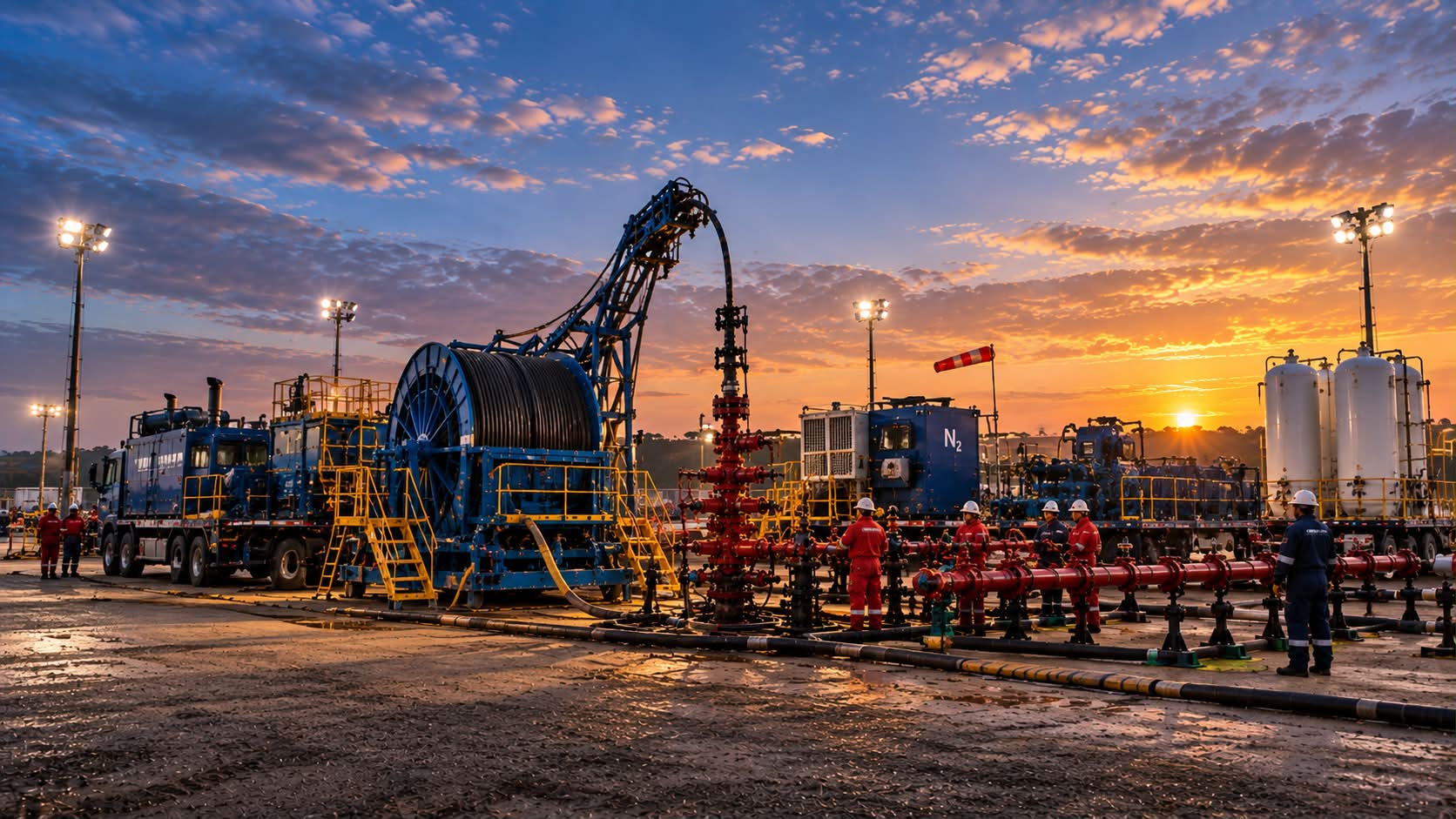 Nitrogen unit and storage on location
Nitrogen
Nitrogen is where inexperienced crews get hurt. Training covers the cryogenic hazards and the pumping practice in equal measure, on the specific converter and pump units the client operates.
Properties and hazards
Cryogenic burns, asphyxiation risk, expansion ratios, confined-space precautions and PPE.
Equipment
Transport tanks, pump and vaporiser units, pressure and temperature limits, cold-end maintenance and pre-job checks.
Applications
Kick-off and unloading, lifting with coil, foam and energised fluids, purging and inerting, pressure testing.
Calculations
Volume and rate requirements at downhole conditions, bottom-hole pressure estimation and job monitoring.
 Pump units and fluid lines rigged to the wellhead
Fluid Pumping
Pump operators and engineers working on high-pressure fluid ends need to understand both the iron and the fluid. Courses combine equipment discipline with fluid handling and job execution.
Pump fundamentals
Triplex and quintuplex pump construction, fluid ends, plungers and valves, rate and pressure limits, rod load.
Surface iron
Treating iron classification, pressure testing, restraint, connection integrity and inspection requirements.
Fluid handling
Mixing, quality control, additive handling, density and rheology checks, and chemical safety.
Execution
Pre-job checks, pressure testing to programme, real-time monitoring, shutdown criteria and post-job reporting.
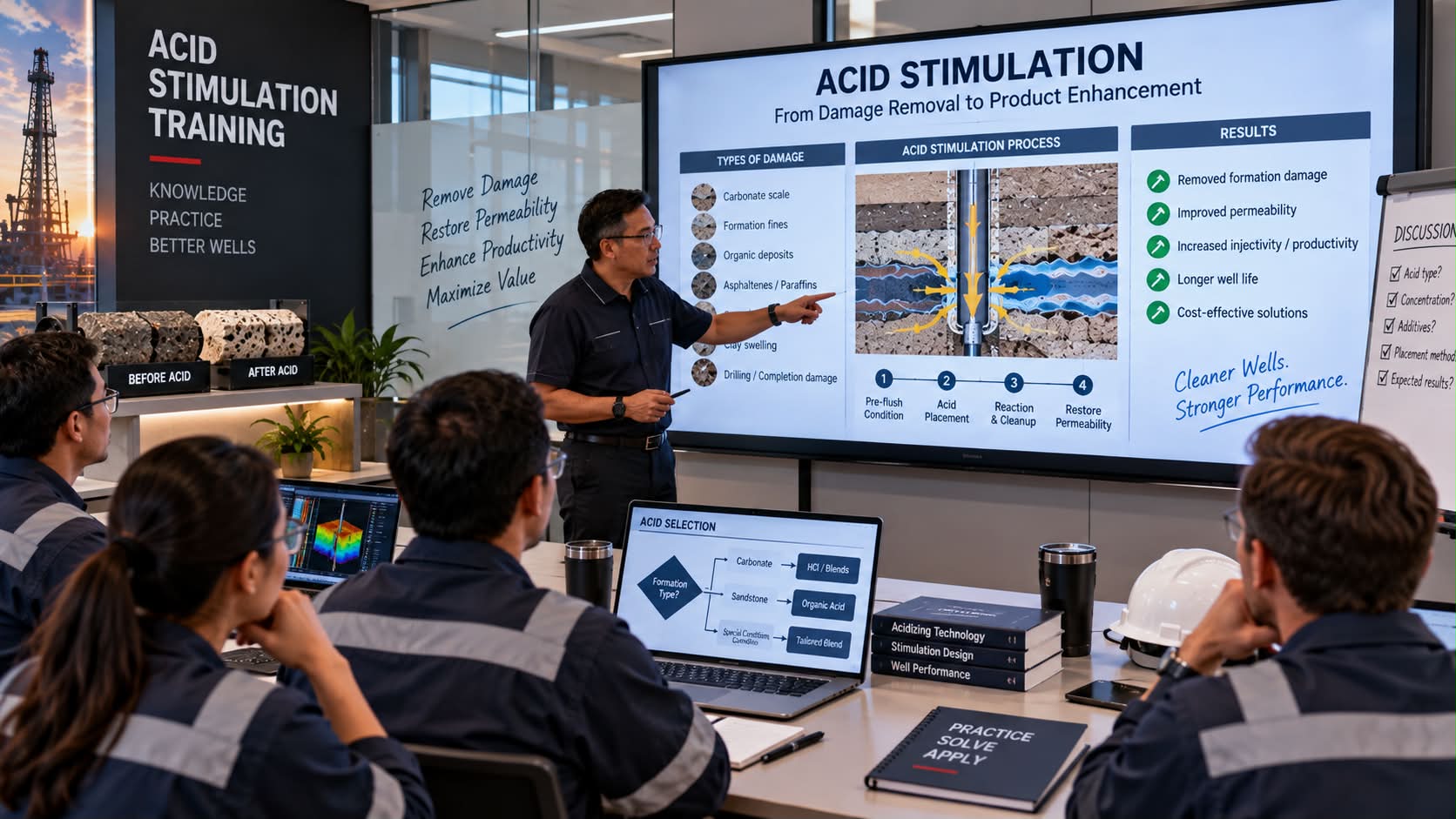 Acid stimulation training in session
Stimulation
Matrix acidising and near-wellbore stimulation, taught from candidate selection through to post-job evaluation, with emphasis on why treatments succeed or fail rather than only how to pump them.
Reservoir basics
Damage mechanisms, skin and candidate selection — including deciding when a well will not respond to stimulation at all.
Fluid systems
Acid systems and additives, retarders and diverters, corrosion inhibition, compatibility testing and laboratory QA/QC.
Design and execution
Treatment design review, pumping schedules, staging and diversion, and real-time pressure interpretation.
Evaluation
Post-job analysis, pressure decline, production response and what to change on the next well.